
Why is the 7-iron the standard practice club?

For many beginners just getting into golf, their first club is often neither a driver nor a putter, but a 7-iron. Whether at the driving range, in lessons, or on a beginner’s list recommended by friends, the 7-iron is almost always the most mentioned option.
But why exactly the 7-iron? Is it really suitable for every beginner?
This article will take you from iron numbering, the positioning of the 7-iron, and the reasons why beginners choose it, all the way to the importance of club fitting, helping you understand the real reasons behind choosing this club.
What is a 7-iron?
In golf, irons are typically identified by numbers, such as 4-iron, 5-iron, 6-iron, 7-iron, 8-iron, and 9-iron, followed by wedges like the Pitching Wedge, Approach Wedge, and Sand Wedge.
These numbers aren't just an arbitrary sequence; they represent design differences. Generally, a lower number means less loft, a longer shaft, and more distance, but it is also harder to control. A higher number means more loft, a shorter shaft, a higher launch, and easier control over direction and landing spot.
The 7-iron sits exactly in the middle of a standard iron set.
The 7-iron is not as long or difficult to hit as a 4- or 5-iron, nor is it as focused on short-distance control as a 9-iron or a wedge.
For beginners, the 7-iron offers a relatively balanced choice in terms of length, weight, loft, and difficulty. Positioned right in the middle, it makes transitioning to longer or shorter irons easier without significant adjustments in swing rhythm or club length, which is why it is considered the ideal club for starting practice.

What are the differences between iron numbers?
The main differences between iron numbers usually come down to a few design factors.
Loft Angle
The loft angle affects the launch height, flight distance, and landing angle of the ball. Lower-numbered irons have lower lofts, which provide more distance but are harder to launch; higher-numbered irons have higher lofts, making it easier to hit the ball high, though they offer less distance.
| Iron Number | Common Loft Range | Characteristics |
|---|---|---|
| 4-iron | Approx. 19–24° | Greater distance, but harder to launch |
| 5-iron | Approx. 22–27° | Longer distance, requires higher consistency |
| 6-iron | Approx. 25–31° | Between long and mid irons |
| 7-iron | Approx. 28–34° | Mid-position, balanced distance and control |
| 8-iron | Approx. 32–38° | Easier to hit high, improved control |
| 9-iron | Approx. 37–43° | Higher trajectory, suitable for short-mid approach |
| PW | Approx. 42–48° | Focused on short distance and accuracy |
※Actual loft angles vary by brand, model, and design; this table is for reference only.
Even among different "7-irons," the actual launch height, distance, and feel can vary significantly by brand. This is why you shouldn't choose a club based solely on its number; you must also consider loft angle, shaft length, weight, and overall configuration to ensure it matches your specific swing characteristics.
Shaft Length
Shaft length impacts swing arc, clubhead speed, and shot consistency. Generally, lower-numbered irons have longer shafts, creating a larger swing arc, which theoretically leads to higher clubhead speed and more distance, but they demand greater accuracy. Higher-numbered irons have shorter shafts, which, while offering less distance extension, provide much better control over direction and consistency.
| Iron Number | Common Shaft Length Range | Characteristics |
|---|---|---|
| 4-iron | Approx. 38.5–39 inches | Longer shaft, more distance, harder to hit the sweet spot |
| 5-iron | Approx. 38–38.5 inches | Longer distance, requires better rhythm and consistency |
| 6-iron | Approx. 37.5–38 inches | Between long and mid irons, better balance |
| 7-iron | Approx. 37–37.5 inches | Mid-position, moderate length, good for fundamentals |
| 8-iron | Approx. 36.5–37 inches | Shorter shaft, easier to control direction/rhythm |
| 9-iron | Approx. 36–36.5 inches | Higher control, for short-mid distance approach |
| PW | Approx. 35.5–36 inches | Shorter shaft, focus on landing and control |
※Actual shaft lengths vary by brand, series, gender specifications, and customization; this table is for reference only.
Because every golfer has a different height, arm length, posture, and swing, a "standard" 7-iron length may not be perfect for you. If a club is too long or too short, your body may compensate during the swing, which is why shaft length is a key assessment factor during Fitting.
Club Usage
Beyond loft and length, each iron is designed for specific distances and flight needs. For the average amateur, a 5-iron is often used for 150–180 yard approaches; a 7-iron covers roughly 120–160 yards with a balance of distance and control; a 9-iron is typically for 90–130 yards with a higher trajectory and steeper landing angle for better precision.
| Iron Number | Common Distance Range | Common Usage |
|---|---|---|
| 4-iron | Approx. 160–190 yards | Long distance approach, bridge between woods and irons |
| 5-iron | Approx. 150–180 yards | Mid-long approach, higher distance requirement |
| 6-iron | Approx. 140–170 yards | Mid-distance approach, balance of distance/control |
| 7-iron | Approx. 120–160 yards | Stable hitting, ideal for beginners |
| 8-iron | Approx. 110–140 yards | Short-mid approach, easier to control direction |
| 9-iron | Approx. 90–130 yards | Shorter approach, higher trajectory, good precision |
| PW | Approx. 80–120 yards | Short distance, landing and stopping control |
※Distance ranges are estimates; actual distances depend on swing speed, ball contact, club specs, and field conditions.
In other words, iron numbers are not about "lower is better" or "higher is easier," but rather that each club serves a unique design purpose. Beginners need a club that balances distance, trajectory, and control, which is why the 7-iron is the common choice.

Why should beginners use a 7-iron?
There are several primary reasons beginners are advised to start with a 7-iron:
Budget Considerations
Not everyone wants to buy a full set of clubs when they first start, as the cost for a complete set can be substantial. If you're unsure about long-term commitment, buying just a 7-iron is a reasonable entry point. Since it is the preferred starting club, most brands also tend to standardize their practice clubs as 7-irons.
Building a Stable Foundation
The 7-iron provides relatively clear feedback. When you hit the sweet spot, the launch, direction, and distance are easy to observe. If you hit fat, thin, or have an unstable clubface, you can easily spot the issue in the ball flight, which is crucial for building good fundamentals.
Mastering Swing Rhythm
The 7-iron sits comfortably in the middle. It is not as difficult to master as a long iron, nor is it limited to short-game practice. Using a 7-iron allows beginners to easily establish basic swing mechanics, including posture, grip, weight transfer, and tempo. Transitioning to other irons is also easier from here; after mastering the 7-iron, moving to 8- or 9-irons feels like managing a shorter, easier club, while moving to 6- or 5-irons allows you to gradually adapt to longer club rhythms. In essence, the 7-iron is an excellent starting point.
Is it okay not to use a 7-iron?
Starting with a 7-iron is a very logical choice for beginners due to its balanced nature and ease of future progression. However, it is not an absolute requirement.
Since everyone has different physical attributes and swing habits, the "perfect" club varies. Some might find a 9-iron easier to launch, while others may feel more comfortable with the rhythm of a 6- or 5-iron, especially if they have a background in other sports. Furthermore, standard set clubs aren't always a perfect match for every golfer's unique body type. If a club is not perfectly suited, your body may naturally compensate, potentially cementing bad habits.
This is why, once you have established a solid foundation, seeking a club Fitting is highly recommended. Golf equipment goes far beyond the clubhead—shaft weight, flex, length, Lie Angle, and grip thickness all impact your performance. A proper fit ensures your equipment doesn't force your body to compensate for design mismatches.
Why is Fitting important?
Many beginners assume Fitting is only for advanced players, but its core purpose is simply to find a configuration that matches your physical conditions and swing characteristics. When you start to feel the differences between clubs, Fitting helps you pinpoint whether your instability is a technical flaw or a mismatch in gear specs.
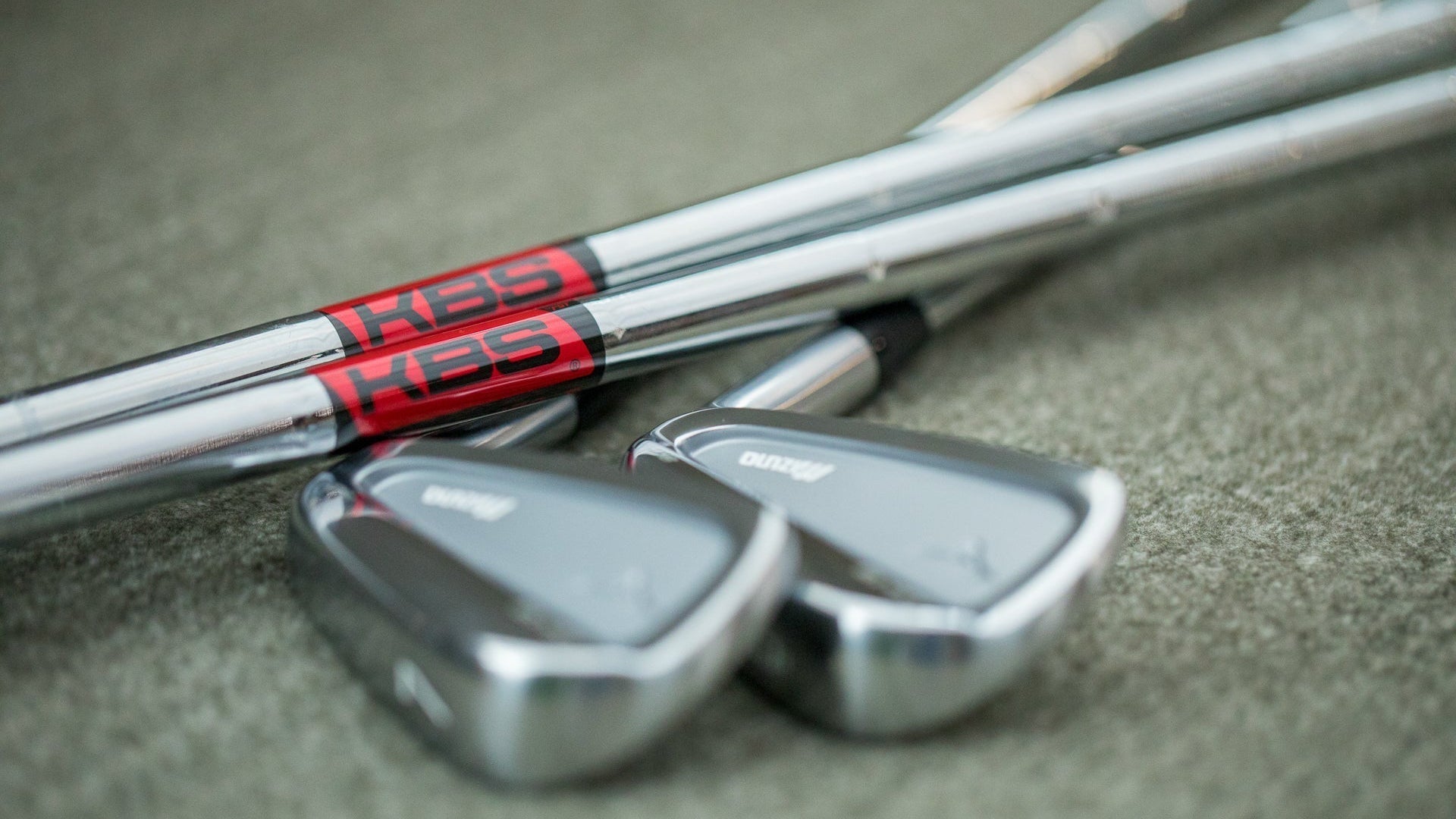
In iron sets, shaft weight, flex, and kick points significantly impact rhythm and feel. A shaft that is too heavy, light, stiff, or soft can hinder progress. KBS emphasizes design and Fitting because the right shaft allows for a natural, stable swing that doesn't force you to change your technique to accommodate the gear.
Conclusion
Are you currently practicing with a 7-iron? Or do you find yourself constantly adjusting your swing just to make your current club work?
If you realize you're compensating for equipment that doesn't fit you, the problem might not be your swing, but your clubs.
Instead of forcing yourself to adapt to inefficient tools, try different clubs at specialized stores to find a weapon that lets you swing naturally and unleash your potential. Consider a professional Fitting to scientifically analyze your swing and find a configuration that matches your physical traits and habits. Once your clubs fit, you can build a stable, correct swing without the need for excessive compensation.
Choosing the right club makes practice more efficient and brings every swing closer to the ball flight you desire.
The shaft brand of choice for nearly 1/3 of the world's professional golfers
Book a Fitting today and let KBS craft a unique club made just for you!
Further Reading
Is 'Lady' flex not actually just for women? Let's debunk the myths of shaft flex labels!
──"What are women's clubs? How are they different from regular clubs?"
Still choosing clubs based on flex labels? Beware of the literal traps in flex markings!
──"Why you shouldn't just look at flex: A guide to understanding the 'hidden traps' in golf shaft flex labels!"